
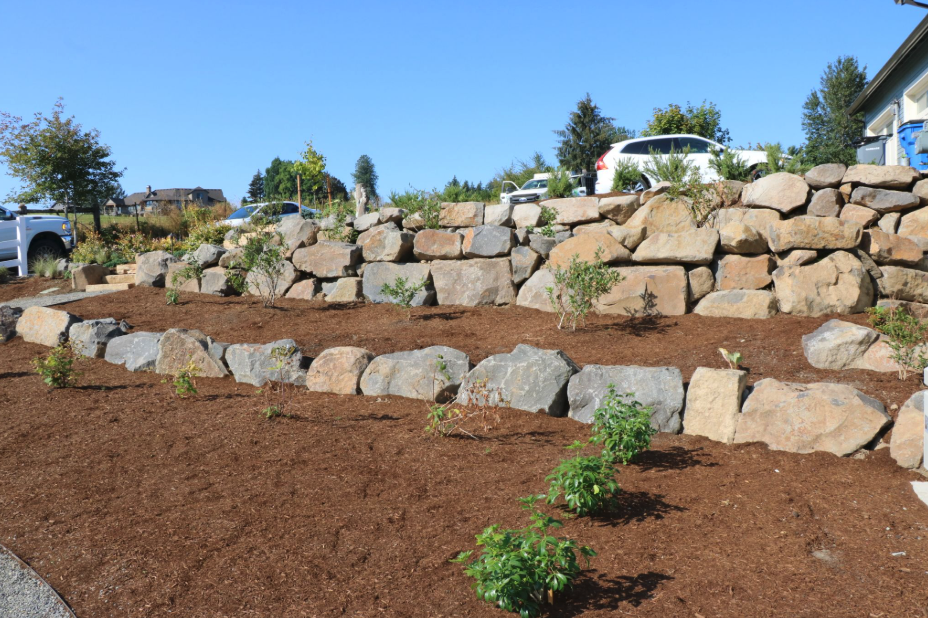
There’s a spot in a lot of Pacific Northwest backyards that nobody talks about — the slope that’s too steep to mow safely, the hillside where nothing stays planted, the chunk of property that’s technically yours but might as well not exist. If you’ve got a yard like that, you know exactly what we mean.
The good news is that difficult terrain isn’t a lost cause. In fact, some of the most beautiful and functional outdoor spaces we’ve created at Greenhaven Landscapes started as yards that homeowners had basically given up on. A well-designed retaining wall — or a series of them — can completely change what’s possible on a sloped or uneven property.
This post is for homeowners who are curious about retaining walls but aren’t sure where to start. We’ll cover what retaining walls actually do, what your material options look like, when a project requires a landscape architect, and what the process looks like from first conversation to finished yard.
What Is a Retaining Wall, Exactly?
A retaining wall is a structure built to hold back soil on a sloped or uneven piece of ground. Its job is to keeping gravity from winning. In practical terms, that means taking a slope and turning it into a series of level, usable areas, or simply stabilizing ground that would otherwise erode or shift over time.
Retaining walls range from simple garden-bed borders a foot or two tall to major engineered structures that require permits, drainage systems, and professional design. The scale of what you need depends entirely on the grade of your property, what you want to do with the space, and whether there’s anything above or below the wall that could be affected if something goes wrong.
What they all have in common is this: done right, a retaining wall doesn’t just solve a problem — it creates opportunity. It turns a liability into usable, beautiful square footage.
Material Options: Rock, Stone, and Block
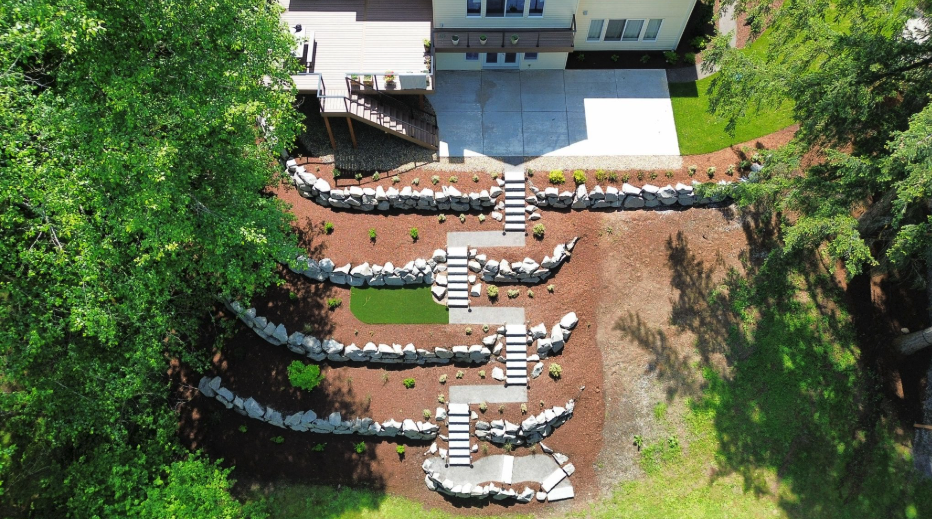
At Greenhaven, we work primarily with two categories of retaining wall materials: natural stone and concrete block systems. Both are durable, attractive, and well-suited to the Pacific Northwest climate. Here’s a quick look at what each brings to the table.
Natural Rock and Stone
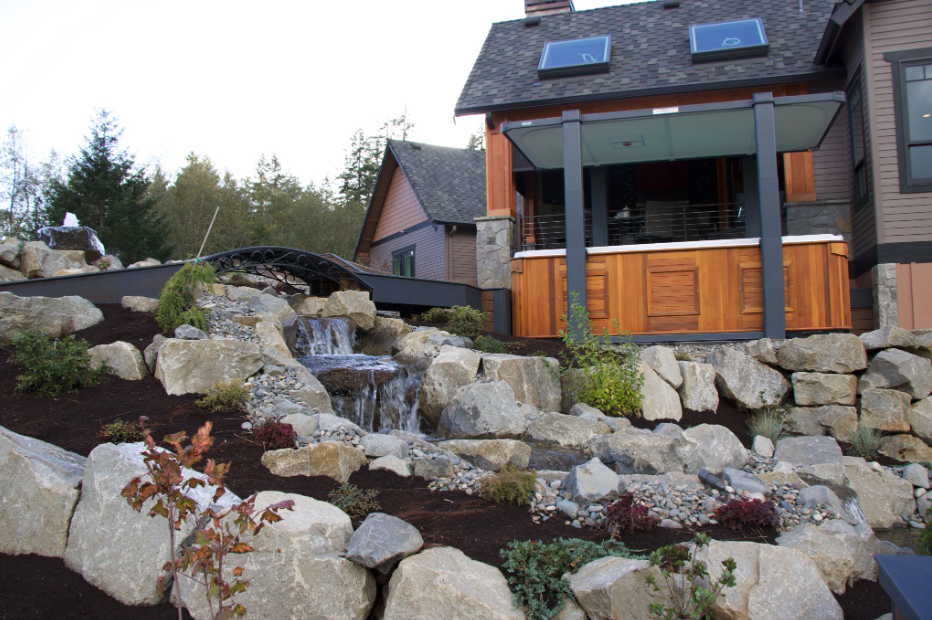
Natural stone walls — whether built from basalt boulders, fieldstone, or cut stone — have a timeless quality that’s hard to replicate. They fit naturally into Pacific Northwest landscapes, and when they’re done well, they look like they’ve always been there. Boulder walls in particular are popular for larger retaining applications where you want a rugged, organic look that blends with the surrounding terrain.
Natural stone is extremely durable and tends to age gracefully — it doesn’t fade, peel, or degrade the way some manufactured materials can. The tradeoff is that it requires skilled craftsmanship to build correctly, and the irregular shapes mean each wall is essentially custom. That’s part of what makes them beautiful, and part of what makes them worth doing right.
Concrete Block Retaining Wall Systems
Segmental concrete block systems — brands like Allan Block, Versa-Lok, and similar engineered systems — are another excellent option. These interlocking block systems are engineered for retaining wall applications, which means they’re designed to handle lateral soil pressure, integrate with drainage, and meet code requirements for taller walls.
Block systems offer a clean, structured look that works beautifully in more contemporary or formal landscape designs. They’re also highly versatile — available in a range of colors, textures, and profiles — and because they’re modular, they can follow curves and angles that would be difficult to achieve with natural stone.
The right choice between stone and block often comes down to the aesthetic of your property, the scale of the project, and your goals for the surrounding landscape. Both are solid, long-lasting options when properly installed with appropriate drainage.
What Can a Retaining Wall Actually Do for Your Yard?
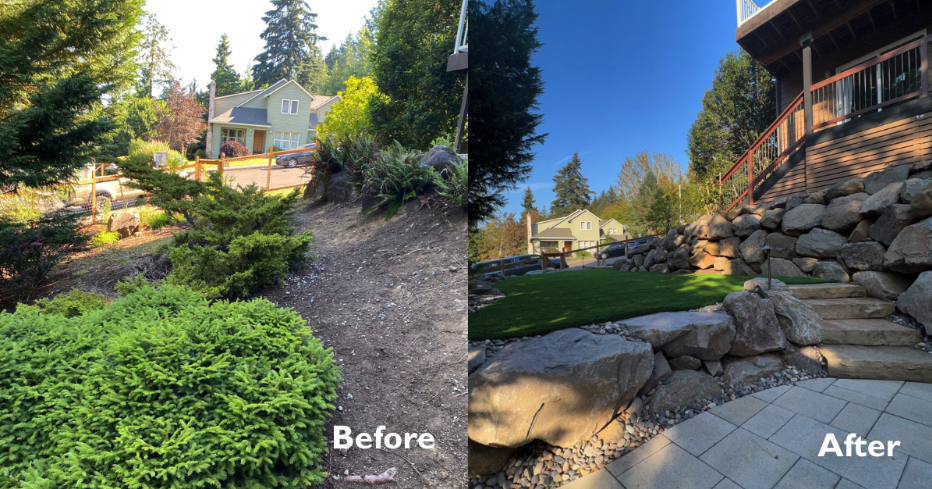
This is where things get interesting. Most homeowners think of retaining walls as purely practical — a fix for erosion, a way to keep a slope from sliding. And yes, they do that. But the best retaining wall projects go further than that, turning problem areas into genuine outdoor living space.
Turn Slopes Into Usable Space
Terracing is one of the most powerful tools in landscape design. By stepping a slope down through a series of retaining walls, you can create multiple flat areas at different elevations — each one usable for something different. A patio here, a garden bed there, a flat lawn section for the kids. What was previously a frustrating, unusable hillside becomes a layered, purposeful outdoor space.
Stop Erosion Before It Becomes a Problem
In the Pacific Northwest, erosion is a genuine concern — especially for properties with heavy clay soil, significant grades, or areas near creek corridors. Every heavy rain moves a little more soil, undermines plantings, and slowly reshapes the landscape in ways you didn’t choose. Retaining walls interrupt that process. They hold the soil in place and redirect water rather than letting it carry your yard away season by season.
Improve Drainage Across Your Property
A well-built retaining wall isn’t just a wall — it’s a drainage system. Properly designed walls include gravel backfill and perforated drain pipe behind them, which channels water away from the wall and through the landscape in a controlled way. Done right, a retaining wall project can actually improve drainage across your entire yard, reducing standing water and soggy areas that make your outdoor space less usable.
Add Visual Structure and Curb Appeal
There’s something satisfying about a yard that has definition — where each area feels intentional and the transitions between levels feel designed rather than accidental. Retaining walls do that. They bring structure to a landscape that might otherwise feel chaotic or unfinished, and they create the perfect backdrop for planting. Low-growing perennials, ornamental grasses, and creeping ground covers tucked into tiered walls soften the hardscape and make the whole yard feel cohesive.
Create the Foundation for Outdoor Living
Many of the outdoor living projects we build at Greenhaven Landscapes start with a site evaluation that includes grading and retaining wall work. A level pad doesn’t just happen on a sloped lot — it has to be engineered. Whether you’re dreaming of a patio, a covered outdoor kitchen, a fire pit area, or just a flat space where the kids can actually run around, a retaining wall is often the first step that makes everything else possible.
When Do You Need a Landscape Architect?
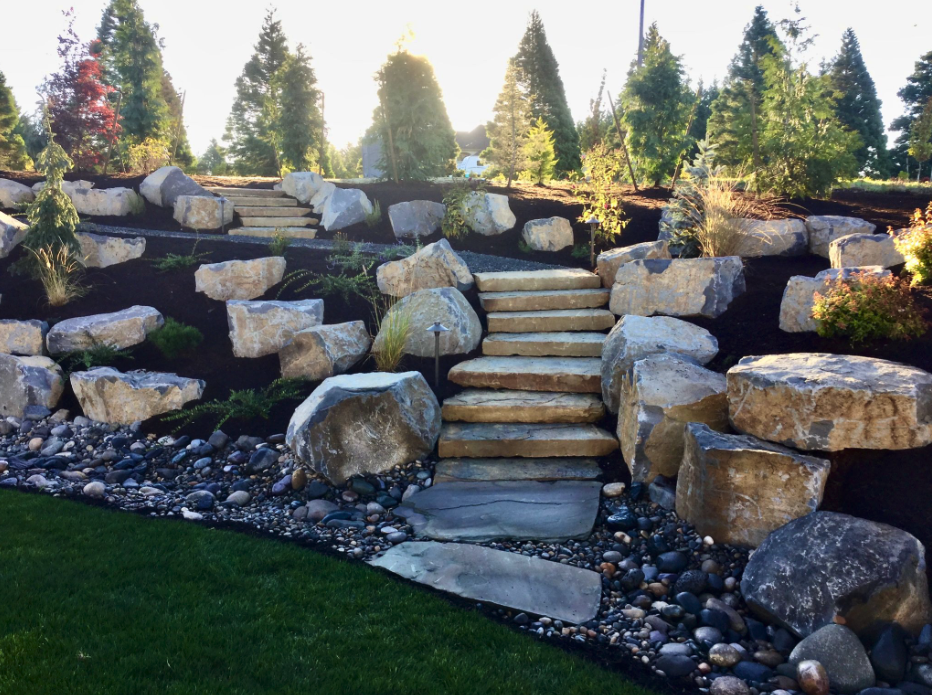
For smaller retaining wall projects — a single wall under four feet, a garden terrace, a simple slope stabilization — a qualified landscape contractor like Greenhaven can typically handle the design and build from start to finish. But there are situations where a licensed landscape architect needs to be part of the picture, and it’s worth understanding the difference.
In Washington State, a landscape architect is generally required when a project involves engineered structural elements, significant grading changes, or walls that exceed the height thresholds set by local jurisdictions. Here’s when you’re most likely to need one:
- Your retaining wall will be over four feet tall (measured from the bottom of the footing), especially if there’s a structure, driveway, or other surcharge above or below it
- The project involves significant changes to drainage or stormwater flow that affect neighboring properties
- Your property is in or near a critical area — a steep slope zone, flood plain, or environmentally sensitive area
- The city or county requires stamped engineered drawings as part of the permit application
- You’re building a tiered wall system with multiple levels that interact structurally
If your project falls into any of these categories, don’t let it discourage you — it just means the planning process involves one more professional. Greenhaven works alongside landscape architects and structural engineers regularly, and we can help you understand what your project requires before you’re deep into the process. Often, the site consultation is what clarifies this.
Do You Need a Permit?
The short answer: it depends on wall height, location, and what’s nearby. In most Washington jurisdictions — including Clark County and the City of Vancouver — retaining walls over four feet from the bottom of the footing to the top of the wall require a building permit and, in many cases, engineered drawings.
There are also situations where the threshold is lower. If there’s a driveway, structure, or significant weight-bearing load — permit requirements may kick in at a lower height. Walls in critical areas or near property lines have their own rules too.
The important thing to know is that Greenhaven handles the permit research and application process for our clients. You don’t have to spend an afternoon on the Clark County permit portal trying to figure out what applies to your property. We do that leg work, and we make sure projects are built to code from the ground up — which protects your investment and keeps you out of trouble down the road.
What Does the Process Actually Look Like?
If you’ve never done a landscape project of this scale before, it can feel like a big unknown. Here’s a general picture of what working with Greenhaven on a retaining wall project looks like.
1. Free Consultation and Site Visit
We come out to your property, walk the site with you, and talk through what’s going on. We’re looking at the grade, the soil, how water moves across the property, and what you ultimately want to do with the space. This is also where we can tell you whether your project is straightforward or whether it’s going to require a permit or a landscape architect — before you’ve spent a dime.
2. Design and Proposal
Once we understand your goals, we put together a design and proposal that covers material options, scope of work, drainage approach, and project cost. We want you to understand exactly what you’re getting before anything moves forward.
3. Permitting (If Required)
If your project requires a permit, we handle the application and coordinate with any required engineers or architects. This step adds time to the front end of the project, but it’s handled on our end — you’re not chasing paperwork.
4. Installation
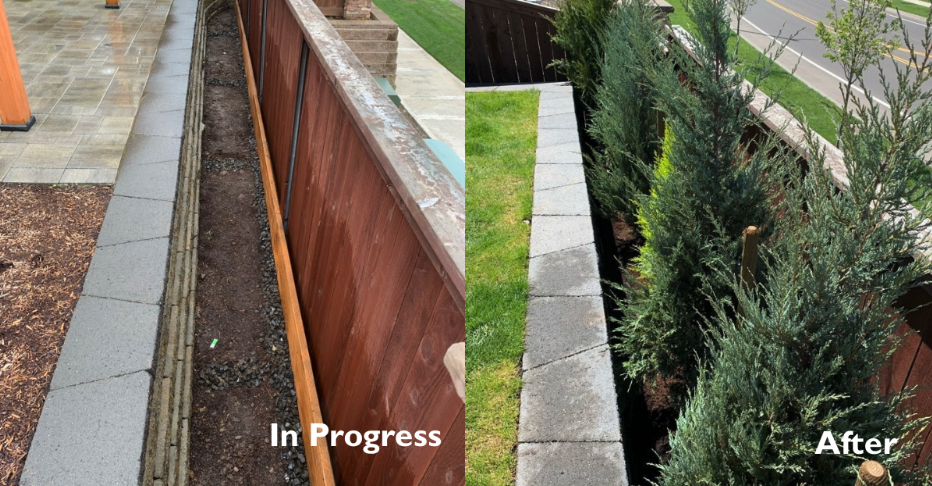
Depending on the scale of the project, installation involves excavation, base preparation, wall construction, drainage installation, and backfill. Larger projects may involve equipment like mini excavators or skid steers. It can look a little chaotic mid-project, but our crews work clean and communicate throughout.
5. Finishing and Planting
The wall is just the beginning. Finishing work might include soil prep and seeding on newly graded areas, planting in and around the wall, integrating lighting or irrigation, or transitioning into adjacent patio or hardscape work. This is where the project stops looking like a construction site and starts looking like a yard.
Most retaining wall projects — even moderately complex ones — wrap up within a few days to a few weeks depending on scope and permitting timelines.
Is a Retaining Wall Right for Your Yard?
Not every sloped yard needs a retaining wall. Sometimes the right answer is regrading, strategic planting, or a combination of approaches. But if any of the following sound familiar, a retaining wall is probably worth exploring:
- Part of your yard is inaccessible or unsafe because of a slope
- You’re losing soil, mulch, or plantings every time it rains heavily
- You want a flat area for a patio, fire pit, pool, or play space but the grade won’t allow it
- Your yard feels unfinished or visually chaotic because of the terrain
- You have erosion that’s getting worse season over season
- You’re planning a major outdoor living project and need a level pad to build from
The honest answer is that the only way to know for sure is to have someone who knows what they’re looking at walk the property with you. That’s exactly what our free consultations are for.
Ready to Find Out What’s Possible?
If you’ve got a slope, a hillside, or just a chunk of yard that’s never quite worked for you, we’d love to take a look. A conversation with our team usually answers a lot of questions – what would it take to make my yard usable and beautiful?
Retaining Wall Installation in Vancouver, WA
Greenhaven Landscapes serves homeowners throughout Vancouver, WA and the greater Southwest Washington area. We’re a design-build company, which means we handle everything from the initial site visit through final planting — you don’t have to coordinate between a designer and a separate contractor. Contact us today and find out how a retaining wall can help you fall in love with your yard.